
Industrial Bearing Types: Complete Buyer Guide 2026
📋 Quick Navigation — Industrial Bearing Types:
Selecting the right industrial bearing types is critical for maximizing machinery performance, reducing downtime, and optimizing equipment lifespan. Whether you’re sourcing deep groove ball bearings for electric motors, cylindrical roller bearings for heavy gearboxes, or ceramic hybrid bearings for high-speed applications, understanding the full spectrum of bearing types available on the market today is essential for making cost-effective purchasing decisions.
This comprehensive buyer guide covers all major bearing categories—from ball bearings to ceramic bearings—with technical specifications, application guidance, load ratings, and selection criteria used by engineers worldwide. We also include practical sourcing advice for global buyers looking to source industrial bearing types from international suppliers in 2026.
🏭 Industrial Bearing Types at a Glance (2026):
| Ball Bearings | High speed, moderate loads, general purpose | Electric motors, pumps, fans |
| Roller Bearings | High radial load capacity, lower speed | Gearboxes, turbines, mining equipment |
| Tapered Roller Bearings | Combined radial + axial loads, adjustable | Wheel hubs, gearboxes, conveyors |
| Spherical Roller Bearings | Self-aligning, high misalignment tolerance | Crushers, vibrating screens, mining |
| Ceramic Bearings | High speed, corrosion-resistant, lightweight | Aerospace, semiconductor, high-speed machining |
| Stainless Steel Bearings | Corrosion-resistant, food-grade options | Food processing, medical, marine |
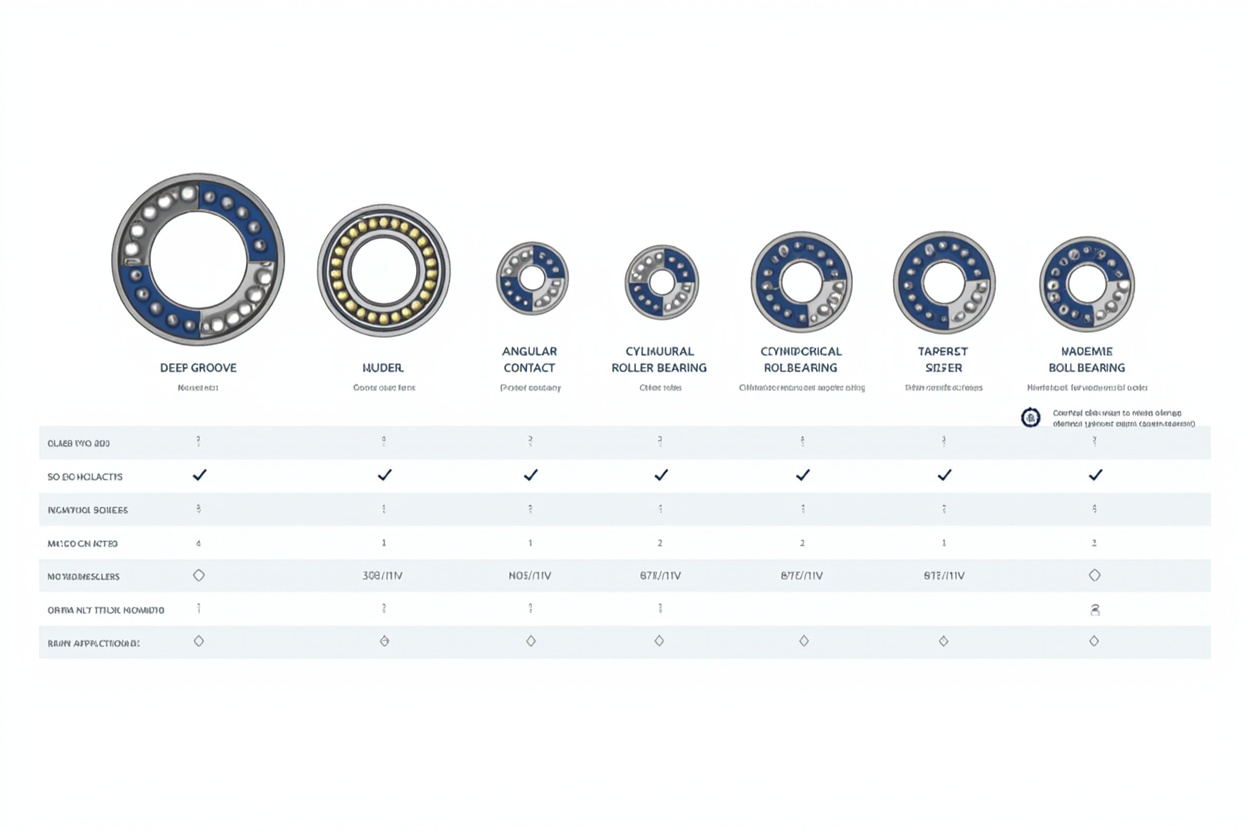
Ball Bearings
Ball bearings are the most widely used bearing type in industrial machinery, utilizing ball elements to reduce rotational friction between moving parts. They handle both radial and axial loads effectively and are typically the first choice for general-purpose applications requiring moderate load capacity and high-speed operation. The ball contact geometry allows for smoother rotation with less friction compared to other bearing designs, resulting in lower operating temperatures and longer service life under standard conditions.
As the workhorse of industrial machinery, ball bearings account for approximately 40% of all bearing sales globally. Their versatile design makes them suitable for a wide range of applications from electric motor drives to agricultural equipment. The sealed variant provides contamination protection in dusty environments without requiring maintenance.
Deep Groove Ball Bearings
For detailed information on sealed deep groove ball bearings designed for harsh environments, visit our specialized guide.
- Handle both radial and axial loads simultaneously
- Optimized for high-speed operation
- Typical applications: electric motors, pumps, fans, conveyors
- Available in open, shielded, or sealed configurations
Deep groove ball bearings are the workhorse of industrial bearing applications, accounting for approximately 40% of all bearing sales globally. Their versatile design accommodates moderate thrust loads in either direction, making them suitable for a wide range of machinery including electric motor drives, gearboxes, and agricultural equipment. The sealed variant provides contamination protection in dusty environments without requiring maintenance.
Angular Contact Ball Bearings
- Engineered for combined radial and thrust load capacity
- High precision for machine tool spindles
- Typical applications: pumps, compressors, gearboxes, printing equipment
- Require proper mounting orientation for optimal performance
Angular contact ball bearings are designed with a contact angle typically between 15° and 40°, which determines their thrust load capacity. Higher contact angles handle greater axial loads but reduce radial capacity. These bearings must be mounted with the loading side oriented correctly—incorrect installation can lead to premature failure due to uneven load distribution across the rolling elements.
Roller Bearings
Roller bearings use cylindrical or tapered rolling elements to distribute loads over larger contact areas than ball bearings, making them ideal for high-load applications. The line contact between rollers and raceways provides significantly higher load-carrying capacity compared to the point contact of ball bearings, though typically at lower speed ratings. Roller bearings are the preferred choice for heavy machinery, mining equipment, and industrial gearboxes where load demands exceed ball bearing capacity.
Cylindrical Roller Bearings
Cylindrical roller bearings are ideal for heavy industrial applications including vibrating screens and mining equipment.
- High radial load capacity for heavy machinery
- Accommodate thermal expansion in shafts
- Typical applications: gearboxes, turbines, generators, wind turbines
- Separable design for easy installation and maintenance
Cylindrical roller bearings feature rollers with a length significantly greater than their diameter, providing line contact along the full roller length. This design delivers superior radial load capacity and rigidity, making cylindrical roller bearings the standard choice for gearboxes, turbines, and power generation equipment. The separable inner and outer rings allow for independent handling and installation, simplifying maintenance in large machinery.
Tapered Roller Bearings
- Handle both radial and axial loads in combined configurations
- Adjustable for proper clearance during installation
- Typical applications: wheel hubs, gearboxes, conveyors, construction equipment
- Widely used in automotive and industrial vehicle drivetrains
Tapered roller bearings are engineered with conical rollers that run on conical raceways, allowing them to accommodate combined radial and axial loads with exceptional precision. The adjustable clearance feature during mounting enables precise preload setting for optimal stiffness and running accuracy—critical in gearboxes and spindle applications. This adjustability makes tapered roller bearings uniquely suited for applications requiring tight operational tolerances.
Spherical Roller Bearings
- Self-aligning capability compensates for shaft deflection
- Handle misalignment up to ±2 degrees
- Typical applications: mining equipment, crushers, screens, vibrating machinery
- Preferred for heavy-duty industrial environments
Spherical roller bearings incorporate barrel-shaped rollers that self-align within the outer ring raceway, providing compensation for shaft flexure, thermal distortion, and mounting errors. This self-aligning capability is particularly valuable in mining equipment, aggregate crushers, and vibrating screens where structural deflection and misalignment are common. The high load capacity combined with misalignment tolerance makes spherical roller bearings the dominant choice for heavy industrial machinery operating in demanding conditions.
Thrust Bearings
Thrust bearings are engineered specifically to manage axial (thrust) loads in rotating equipment, making them essential for vertical shaft applications. Unlike radial bearings designed primarily for perpendicular forces, thrust bearings manage parallel loads along the shaft axis. They are commonly used in vertical motor mounts, gearboxes with high thrust loads, pump casings, and crane hook assemblies where gravitational forces create significant axial loading.
- Ball thrust bearings — suitable for low-to-medium speed applications
- Roller thrust bearings — designed for heavier thrust loads and higher pressure
- Typical applications: gearboxes, vertical motors, steering columns, crane hooks
Specialty Industrial Bearing Types
Beyond standard bearings, specialized types address unique operational requirements in demanding environments where standard bearing designs cannot deliver adequate performance or longevity.
Ceramic Bearings
Ceramic hybrid bearings offer superior performance for demanding high-speed applications.
- Hybrid ceramic: Silicon nitride (Si3N4) balls with steel rings — faster speeds, longer service life
- Full ceramic: Complete ceramic construction for extreme environments
- Key benefits: reduced friction, higher speed capability, corrosion resistance, electrical isolation
- Typical applications: aerospace, semiconductor equipment, high-speed machining centers
Ceramic hybrid bearings use silicon nitride (Si3N4) balls paired with steel rings, combining the speed advantages of ceramic rolling elements with the established mounting dimensions of steel bearings. The lower density of ceramic balls reduces centrifugal force at high speeds, enabling 30-50% higher speed ratings compared to all-steel bearings of the same dimension. Full ceramic bearings, where both rings and rolling elements are ceramic, provide ultimate corrosion resistance and electrical isolation for specialized applications in semiconductor manufacturing and medical imaging equipment.
Stainless Steel Bearings
- Superior corrosion resistance for wet or chemical environments
- Food-grade and medical-grade options available
- Typical applications: food processing equipment, medical devices, marine hardware
- Maintain hygiene standards in cleanroom environments
Stainless steel bearings are manufactured from corrosion-resistant steel alloys (typically AISI 440C for martensitic stainless steel) that withstand moisture, chemicals, and repeated washdown cycles without surface degradation. Food and beverage processing equipment requires bearings that tolerate high-pressure water jet cleaning, chemical sanitizers, and temperature extremes—conditions that would rapidly corrode standard chrome steel bearings. Medical device applications demand biocompatible materials that survive repeated sterilization cycles without compromising dimensional accuracy.
Pillow Block Bearings
- Self-contained mounted units with integrated housing
- Easy installation and quick replacement in field conditions
- Typical applications: conveyors, agricultural equipment, material handling systems
- Popular choice for packaging and food production lines
Pillow block bearings integrate a bearing insert within a cast or pressed steel housing that mounts directly to a machine frame or structure. This self-contained design simplifies installation, eliminates custom housing machining, and allows for quick field replacement without realigning the shaft. The pillow block’s versatile mounting footprint and widespread availability make it the preferred choice for conveyor systems, agricultural machinery, and packaging equipment where maintenance accessibility is a priority.
How to Select the Right Industrial Bearing Type
Use this systematic approach to choose the optimal bearing for your specific application requirements:
- Identify Load Type: Determine whether your application involves radial loads, axial (thrust) loads, or combined loads—this narrows your bearing category significantly.
- Calculate Load Magnitude: Evaluate maximum expected load and dynamic conditions to ensure adequate load ratings with appropriate safety margins.
- Determine Operating Speed: Check the required RPM and compare against the bearing’s speed rating (dn value) for thermal compatibility.
- Assess Temperature Range: Confirm operating temperatures fall within the bearing’s material tolerance, especially for high-heat environments.
- Evaluate Environmental Factors: Consider exposure to dust, moisture, chemicals, or corrosive substances that affect material selection.
- Specify Precision Requirements: Match bearing tolerance class (P0 through P4) to your machinery’s alignment and running accuracy needs.
- Plan Mounting Method: Choose between press-fit, adapter mount, or direct shaft mounting based on maintenance accessibility requirements.
Bearing Materials Comparison
Material selection directly impacts bearing performance, longevity, and cost:
| Chrome Steel | Standard material, best balance of cost and performance for general industrial use |
| Stainless Steel | Enhanced corrosion resistance for food, medical, and marine applications |
| Carbon Steel | Economical option for low-stress, non-critical applications |
| Ceramic (Si3N4) | High-speed capability, thermal stability, lightweight, electrical insulation |
| PEEK Polymer | Chemical resistance, maintenance-free operation, suitable for clean environments |
Quality Certifications Your Supplier Must Provide
Sourcing industrial bearing types from certified suppliers protects your equipment investment and ensures consistent performance:
- ISO 9001: Quality management system certification
- ISO 281: Bearing life calculation and dynamic load ratings
- Original Manufacturer Certificate: Confirms genuine products, not counterfeit
- Full Technical Documentation: Material certifications, test reports, traceability records
Frequently Asked Questions
What are the most common industrial bearing types?
The most common types are deep groove ball bearings, angular contact ball bearings, cylindrical roller bearings, tapered roller bearings, and spherical roller bearings—collectively representing over 80% of industrial bearing applications. Deep groove ball bearings alone account for approximately 40% of global bearing consumption due to their versatility and broad applicability across industries.
How do I know which bearing type my equipment needs?
Match your bearing selection to load type (radial/axial/combined), speed requirements, and environmental conditions. When in doubt, consult the equipment manufacturer’s bearing specification or contact a bearing specialist. The three primary selection criteria are load direction, magnitude, and operating speed—once these are defined, the bearing type options narrow considerably.
What is the difference between ball bearings and roller bearings?
Ball bearings use spherical rolling elements and excel at high-speed operation. Roller bearings use cylindrical, tapered, or spherical rolling elements to handle higher radial loads with greater contact area. The transition from ball to roller bearings is typically made when radial load requirements exceed the practical capacity of available ball bearing sizes.
How long do industrial bearings typically last?
Bearing service life depends on load, speed, lubrication, and environmental conditions. Under proper operating conditions, industrial bearings typically deliver 20,000–50,000 operating hours. The ISO L10 life calculation (L10 = (C/P)³ × 10⁶ revolutions) provides a standardized prediction of the life at which 10% of bearings will fail due to material fatigue.
Can ceramic bearings improve my machinery performance?
Ceramic hybrid bearings offer 30-50% higher speed capability, reduced friction losses, and longer lubricant life—ideal for high-speed pumps, motors, and precision equipment when budget permits. The higher initial cost is often justified by extended service intervals and reduced maintenance downtime in critical applications.
For quality assurance before sourcing, review our bearing quality inspection guide with 6 essential testing methods.
Where can I source industrial bearing types for export?
China is the world’s largest bearing manufacturing hub, with major production centers in Luoyang (Luoyang LYC), Shanghai, and Ningbo. Working directly with bearing manufacturers or authorized distributors ensures traceability, competitive pricing, and access to full technical documentation for international buyers.
Summary: Key Industrial Bearing Types for 2026
This guide has covered all major industrial bearing types including ball bearings (deep groove, angular contact), roller bearings (cylindrical, tapered, spherical), thrust bearings, and specialty types (ceramic, stainless steel, pillow block). Each bearing type serves specific application requirements in terms of load capacity, speed rating, misalignment tolerance, and environmental resistance.
For buyers sourcing industrial bearing types in 2026, the key takeaway is: match your bearing selection to your actual load, speed, and environmental requirements rather than over-specifying. Consult technical specifications carefully and work with certified suppliers who can provide full documentation, material certificates, and traceability records.
Need expert guidance on bearing selection for your application?
Contact our bearing specialists:
📞 Phone/WhatsApp: +86-18698853189
📧 Email: [email protected]
For deeper technical guidance on bearing selection, read our complete industrial bearing selection guide. To understand common failure modes, see our bearing failure analysis guide. For lubrication best practices, visit our bearing lubrication guide.