
Reading industrial bearing specifications correctly is one of the most foundational skills for engineers, procurement managers, and maintenance teams. Misinterpreting a bearing designation can mean ordering the wrong product, causing costly production delays and equipment failures. This guide breaks down every element of a bearing specification sheet so you can confidently identify exactly what you need — whether you are sourcing from a Chinese manufacturer or selecting from an international catalog.
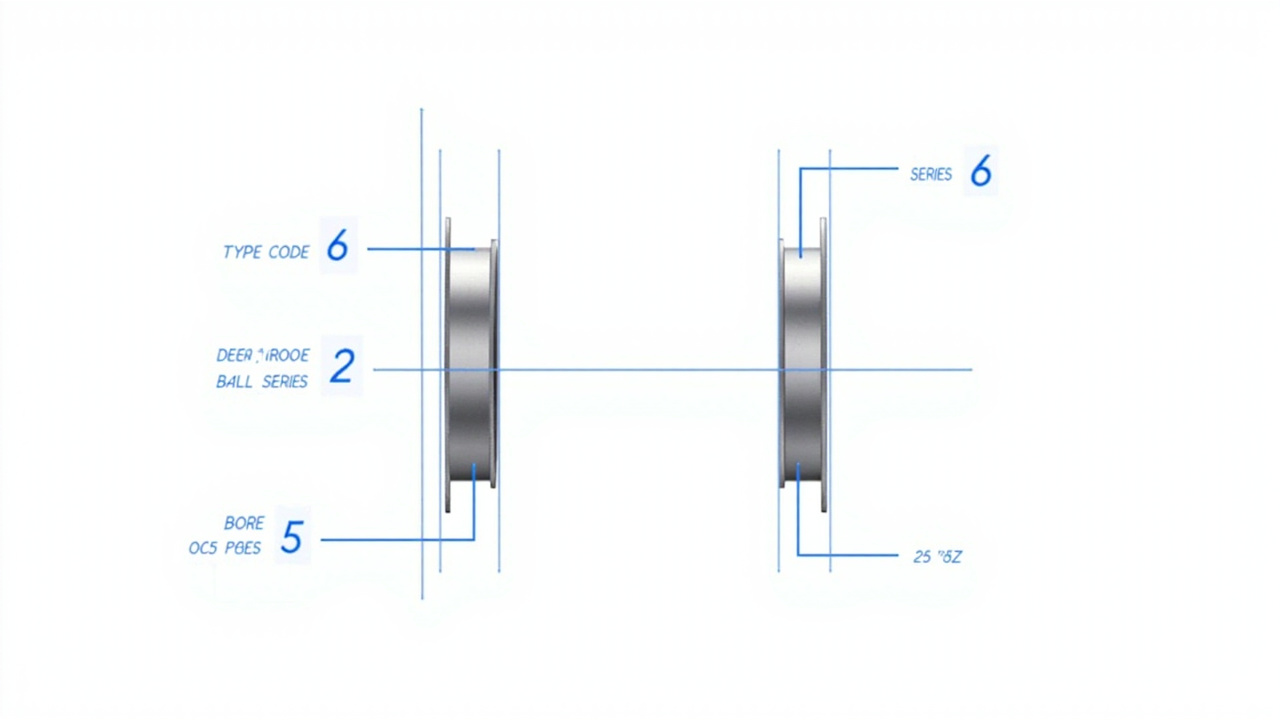
How to Read Industrial Bearing Specifications
Why Understanding Bearing Specifications Matters
Industrial bearings are precision-engineered components with tightly controlled dimensional and performance parameters. A single bearing designation like 6205-2Z encodes critical information: bore diameter, series, seal type, precision class, and more. When procurement teams or engineers misread these codes, the consequences range from incompatibility issues to premature equipment failure.
For international buyers sourcing from China, understanding these specifications is especially important. Many suppliers provide technical data sheets in metric units with coded designations that follow international standards. Being able to read and verify these specifications independently protects you from receiving products that do not match your requirements.
The Basic Bearing Designation System
Most industrial bearing designations follow the ISO 15:2017 standard for ball bearings and ISO 10317:1992 for roller bearings. A typical designation breaks down into five core components:
1. Bearing Type Code
The first character or characters identify the bearing type:
- 6 = Deep groove ball bearing
- N = Cylindrical roller bearing
- UK = Tapered bore self-aligning bearing
- 5 = Angular contact ball bearing
- Q = Thrust ball bearing
For combined-load applications, spherical roller bearings (213 series) or tapered roller bearings (302, 303, 320 series) are the standard choices. Understanding the type code is your first step in narrowing down the correct bearing category.
2. Series Code
The second digit indicates the bearing series, which relates to the cross-sectional height and load-carrying capacity:
- 0 = Extra-light series
- 2 = Light series
- 3 = Medium series
- 4 = Heavy series
For general industrial machinery, light (2) and medium (3) series cover the majority of applications. Heavy series (4) bearings are reserved for applications with exceptionally high radial loads, such as steel mill equipment or large mining crushers.
3. Bore Diameter Code
The last two digits of a bearing designation, multiplied by 5, give the bore diameter in millimeters. This is the most critical dimension when matching a bearing to a shaft:
- 05 = 25 mm bore
- 06 = 30 mm bore
- 08 = 40 mm bore
- 10 = 50 mm bore
- 12 = 60 mm bore
- 15 = 75 mm bore
- 20 = 100 mm bore
For bore diameters below 10 mm or above 500 mm, manufacturers typically write the full millimeter value directly (for example, 608 for 8 mm bore, or 61860 for a 300 mm bore bearing).
4. Seal and Shield Codes
Suffix letters after the bore diameter code indicate seal and shield configurations:
- Z = Single shield on one side
- ZZ = Shields on both sides
- 2RS = Contact seal on both sides (rubber-clad steel)
- 2RZ = Non-contact seal on both sides
- 2Z = Shields on both sides (same as ZZ)
- NR = Shield with snap ring groove on one side
For dusty or contaminated environments, 2RS sealed bearings provide the best protection. For high-speed applications where seal friction is a concern, ZZ shields or open bearings with appropriate lubrication are preferable. Non-contact seals (2RZ) offer a middle ground with decent contamination protection and lower drag.
5. Precision Class (ABEC Rating)
Precision is indicated by ABEC grades (Annular Bearing Engineers Committee), typically listed as a suffix:
- P0 or ABEC 1 = Standard precision (most industrial applications)
- P6 or ABEC 3 = Higher precision with tighter tolerances
- P5 or ABEC 5 = High precision for machine tools and pumps
- P4 or ABEC 7 = Very high precision for demanding applications
- P2 or ABEC 9 = Ultra-precision for aerospace and medical imaging
For general export orders, P0 (ABEC 1) bearings offer the best value. When your application demands smooth operation at high speeds or minimal vibration — such as in electric motor spindles or precision gearboxes — upgrade to P5 or P6 precision grades.
Decoding a Full Bearing Specification
Let us walk through a complete example: 6310-2Z P5
- 6 = Deep groove ball bearing
- 3 = Medium series
- 10 = 50 mm bore diameter
- 2Z = Shields on both sides
- P5 = ABEC 5 precision grade
This bearing is a 50 mm bore, medium-series deep groove ball bearing with dual shields and high precision — suitable for high-speed industrial motors or pump applications where vibration must be minimized.
Key Technical Parameters Beyond Designation
Beyond the bearing designation, specification sheets typically include several additional technical parameters that are essential for proper selection:
Dynamic Load Rating (C)
The dynamic load rating, expressed in kilonewtons (kN), represents the load a bearing can withstand for one million revolutions under ideal laboratory conditions. The ISO life equation uses this value to calculate the theoretical L10 service life. When comparing bearings of the same bore size, a higher C value indicates superior load-carrying capacity.
Static Load Rating (C0)
The static load rating represents the maximum load a stationary bearing can handle without permanent deformation of the rolling elements or raceways. For applications with significant static or shock loads, always verify that C0 exceeds your maximum static load requirement.
Limiting Speed (RPM)
The limiting speed specification indicates the maximum recommended rotational speed, accounting for bearing design, lubrication, and load conditions. Using a bearing above its limiting speed causes rapid heat generation and accelerated fatigue. For high-speed applications, consider ceramic hybrid bearings which tolerate significantly higher dn values.
Fill Angle and Load Distribution
The fill angle describes how the rolling elements are arranged within the bearing. Open bearings have a larger fill angle (allowing more balls for higher load capacity), while shielded or sealed bearings sacrifice some load capacity for environmental protection. Understanding this trade-off helps you select the right bearing for your priority — maximum load or maximum protection.
Common Specification Mistakes That Cost Buyers
- Ignoring the precision class: Misreading bearing codes like confusing P0 for P5 leads to bearing failure — always match ABEC rating to application requirements.
- Confusing seal types: 2RS and 2Z look similar but offer very different protection levels. 2RS contact seals block fine particles and moisture far more effectively than non-contact 2RZ seals.
- Forgetting bore diameter units: The “05” in 6205 means 25 mm, not 5 mm. Always multiply the last two digits by 5 for standard-series bearings.
- Overlooking shaft tolerance: The bearing specification is only half the equation. Shaft tolerance (h6, h7, k6, etc.) must complement the bearing’s mounting tolerance for a proper fit.
- Not verifying C and C0 values: Bearings from different manufacturers with identical designations can have meaningfully different load ratings depending on materials, heat treatment, and manufacturing precision.
How to Use This Knowledge When Sourcing from China
When requesting quotations from Chinese industrial bearing suppliers, always provide the complete designation including precision class, seal type, and any special requirements (high-temperature steel, stainless steel, etc.). Vague requests like “50 mm ball bearing” will generate multiple quotations for completely different products.
For quality-critical applications, ask the supplier to provide the manufacturer’s test report showing actual measured values for dynamic load rating, noise levels, and dimensional tolerances. Reputable Chinese manufacturers with ISO 9001 certification can provide this documentation readily.
Conclusion
Reading industrial bearing specifications correctly is a skill that pays dividends across every stage of procurement and equipment maintenance. The ISO designation system provides a compact but information-dense code that, once understood, lets you decode any bearing’s key characteristics at a glance.
Whether you are selecting bearings for a new equipment build or sourcing replacement parts from international suppliers, a thorough understanding of type codes, series ratings, bore diameter conventions, seal configurations, and precision classes ensures you order exactly what your application demands.
Need help selecting the right bearing for your specific application? Contact our technical team at DHJ International Trading for personalized bearing selection support and competitive export pricing for orders of any size.
WhatsApp: +86-18698853189
Email: [email protected]